
Important! The CPUC will be voting on the PCIA Track 2 Proposed Decision on September 17.
- The CPUC adopting the PD means customers who have since become CCA customers receive no credit for the banked RECs for which they paid. Bundled customers, meanwhile, get to have PG&E use those RECs for compliance for free.
- The CPUC is moving this PD through on the Consent Agenda, rather than discussing it on the regular agenda. The CPUC should move the item to the regular agenda and explain publicly at the meeting why they are adopting the outcome just discussed.
More on CalCCA’s response to the CPUC’s Proposed Decision here: https://cal-cca.org/calcca-urges-cpuc-to-reject-proposal-that-denies-cca-customers-benefits-they-paid-for/.
Information on how to watch or participate in the CPUC meeting here: https://www.cpuc.ca.gov/events-and-meetings/cpuc-voting-meeting-09-17-26.
What is the PCIA?
The PCIA, or Power Charge Indifference Adjustment, is a fee charged by investor-owned utilities (IOUs) in California to all customers, including those who receive generation service from a Community Choice Aggregator (CCA) or Electric Service Provider (ESP). In the past, the PCIA has been known as an “exit fee” but this is a misnomer. The PCIA recovers the IOUs’ above-market costs for power contracts or resources that were acquired on behalf of customers prior to their departure to an alternative energy provider.
Due to the dynamics of inputs to the PCIA, the fee can vary dramatically from year to year. These variations create rate volatility for all customers. CalCCA believes structural changes are needed to decrease PCIA volatility and ensure the PCIA calculation more accurately reflects the full value of IOU energy resource portfolios so that it is properly recovered from customers equitably.
How is the PCIA Calculated?
The PCIA is set annually in the IOUs’ Energy Resource Recovery Account (ERRA) Forecast proceedings. It includes above-market costs related to power supply commitments that the IOUs made many years ago. Above-market means the cost of the resource is higher than the revenue the resource generates. These include Utility-Owned Generation (UOG) (e.g., natural gas, hydroelectric plants) and long-term power purchase agreements with third parties.

The PCIA is intended to leave all customers indifferent to a customer taking up service with a CCA or other alternative. Customers are assigned “vintages” based on the year they moved to CCA service and are responsible for the above-market costs incurred on their behalf before they switched service. Bundled customers, or customers who take both generation and transmission and distribution (T&D) services from an IOU, are always assigned the current year as their vintage.
The PCIA is derived from the utility’s indifference amount, which is updated annually in each IOU’s ERRA Forecast proceeding. The indifference amount is the difference in the target year between the cost of the IOU’s supply portfolio and the market value of the portfolio.

A low indifference amount and subsequent PCIA savings can result from either the cost of the portfolio going down or the value going up. The portfolio value is calculated using Market Price Benchmarks (MPBs), which have experienced extreme variability in recent years.
CalCCA PCIA Bill
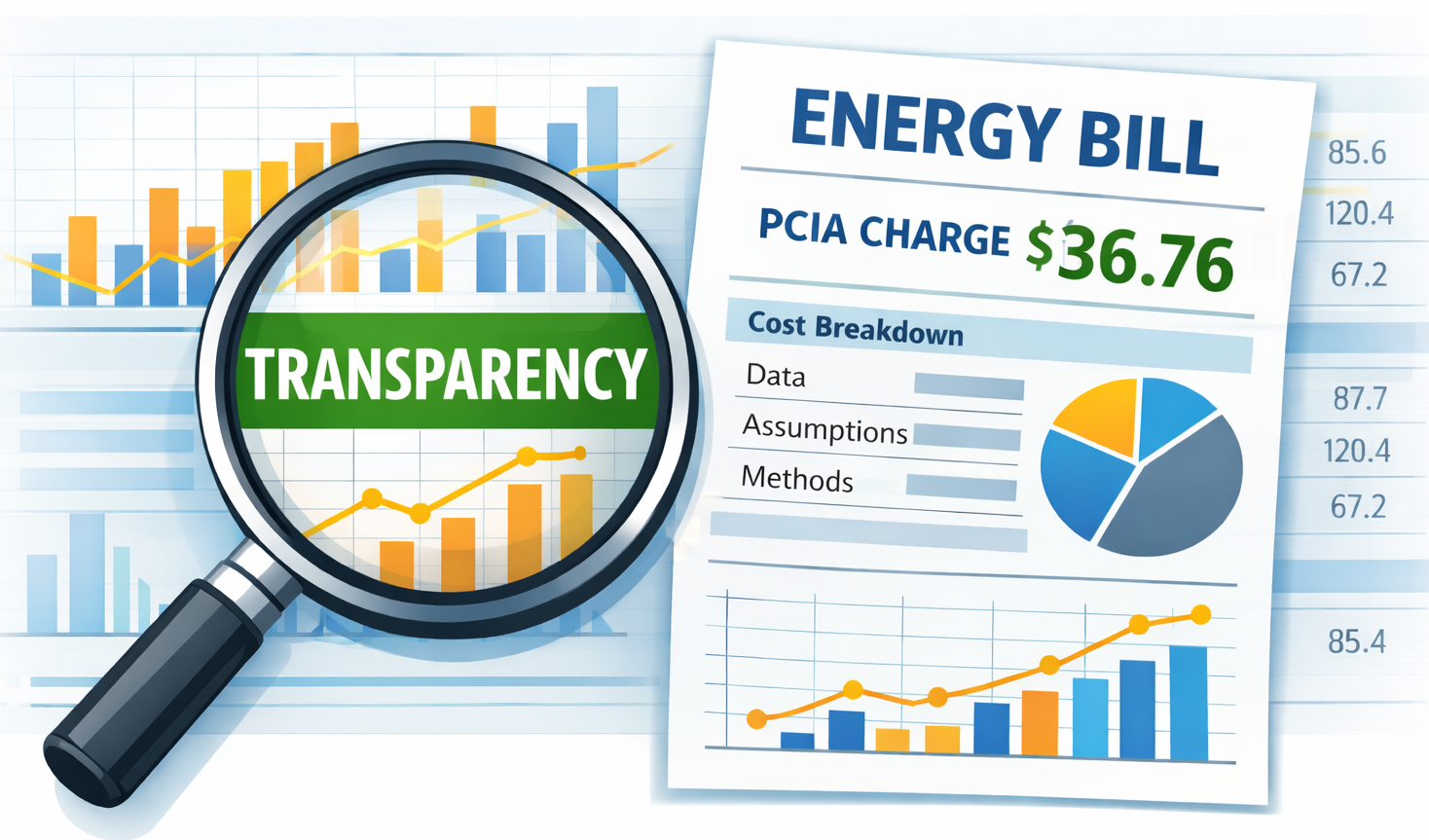
CalCCA sponsored AB 1761, authored by Assemblymember Chris Rogers (D-Santa Rosa), which aimed to bring transparency to the way the Power Charge Indifference Adjustment (PCIA), a charge on nearly all energy bills, is calculated. More on the bill here: cal-cca.org/ab-1761/.
Watch the video to understand the PCIA and the need for better transparency.
PCIA News & Updates
PCIA Swings
When the current market value of IOU power portfolios is lower than what the utility originally paid, the PCIA increases, and departed customers pay the difference. If the value of IOU portfolios is higher than what the utility originally paid, the PCIA decreases, and bundled IOU customers pay the difference. When the forecasted indifference amount diverges from the realized amount, the difference is trued up; this is captured by the Portfolio Allocation Balancing Account (PABA).
Over the past decade, CCA customers experienced dramatic increases in the PCIA to the tune of hundreds of millions of dollars. More recently, in 2024 and 2025, IOU portfolio values increased to overtake portfolio costs. As value surpassed costs, IOU bundled customers were hit with significant PCIA increases in order to provide the value back to departed customers who were owed.
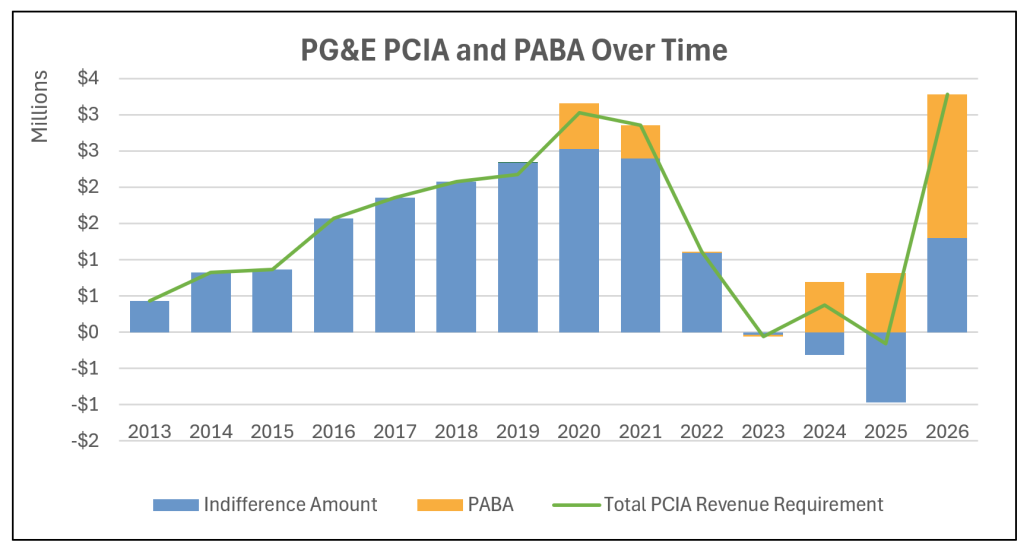
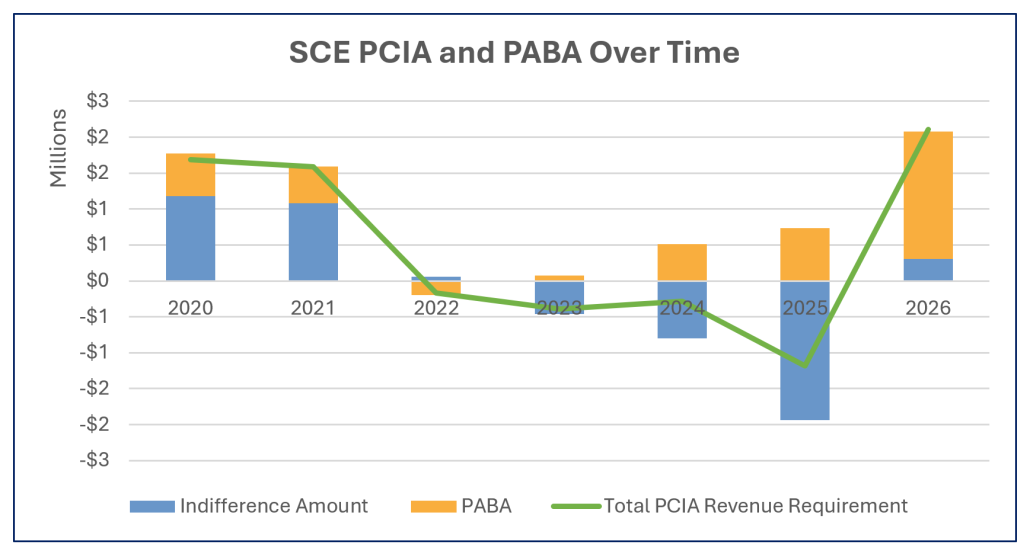
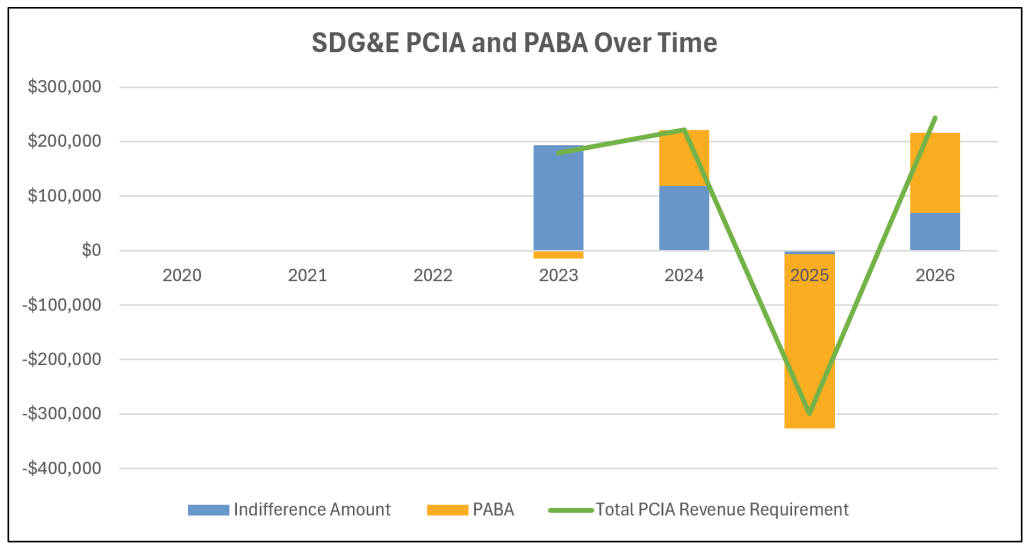
In recent years, the indifference amount has not only varied from positive to negative but also changed significantly in total magnitude, from over $2.5 billion to tens of thousands in PG&E’s case, as shown in the graph above. These dramatic swings in the PCIA have led the California Public Utilities Commission (CPUC) to reconsider the current PCIA methodology.
PCIA Changes Ahead?
In February 2025, the CPUC issued an Order Instituting Rulemaking (OIR) to evaluate potential changes to the methodology used to calculate the PCIA with the goals of improving utility ERRA cost forecasting, mitigating rate volatility, and ensuring indifference among bundled and departed customers.
The OIR separates potential changes into three tracks. Track 1 is considered modifications to the Resource Adequacy (RA) MPB calculation. In June 2025, the CPUC released a decision on track one which modifies the RA MPB and applies it to the 2025 and future ERRA calculations. The decision expands the timeframe of the dataset underlying the RA MPB.
CalCCA requested rehearing of this decision on the grounds that applying the new RA MPB methodology to the 2025 revenue requirement violates the statutory prohibition against retroactive ratemaking, which protects rate stability and prevents after-the-fact changes to approved rates. The CPUC denied CalCCA’s request.
In December 2025, CalCCA filed a Petition for Writ of Review challenging the CPUC’s decision, continuing its argument that the CPUC’s action constitutes unlawful retroactive ratemaking. The petition also asserts that the CPUC lacked adequate findings or evidence to change the existing methodology. CalCCA’s Writ Petition was rejected in June 2026, and appealed to the California Supreme Court, where it is currently pending.
In January 2026, CalCCA and CCA members requested rehearing of the CPUC’s decisions approving PG&E’s, SCE’s, and SDG&E’s 2026 ERRA forecast applications. The PG&E, SCE, and SDG&E rehearing requests challenge the CPUC’s implementation of the new RA MPB in 2025 PCIA rates, on the same unlawful retroactive ratemaking grounds argued in the Track 1 appeals. The PG&E and SCE rehearing requests also challenge the zero valuation of Pre-2019 Banked Renewable Energy Credits (RECs) in the PCIA. CalCCA argues that a share of those RECs was paid for by customers that later departed, and that those customers should receive value when the IOU decides to take them out of the bank to use for bundled customer Renewables Portfolio Standard (RPS) compliance. Given the CPUC failed to issue decisions on the rehearing requests, which were therefore “deemed denied,” CalCCA and CCA members filed Petitions for Writ of Review in July 2026 in the appeals courts for each of the IOUs’ 2026 ERRA Forecast applications. Those Petitions remain pending.
Track 2 considers the narrow issue of Pre-2019 Banked REC valuation for 2026 and later (the 2026 ERRA Forecast decisions only address valuation for 2025). In a September 2026 vote, the CPUC rejected CalCCA’s comments, which means customers who have since become CCA customers receive no credit for the banked RECs for which they paid. CalCCA requested rehearing of this decision on the grounds of several errors, including because it fails to address CalCCA’s proposed cost-neutral allocation alternative.
A third track has been designated to potentially examine a broad range of remaining PCIA issues depending on the scoping ruling to be issued. CalCCA has proposed addressing a broad scope of issues in Track 3, including CCA access to IOU and CPUC data to analyze proposals for PCIA reform and other potential indifference framework structural changes, ranging from structural changes to the indifference methodology to portfolio optimization to benchmark mechanism reform.
Our PCIA Work Continues
CalCCA will continue to advocate for PCIA solutions that reduce costs and increase stability for all ratepayers.


